
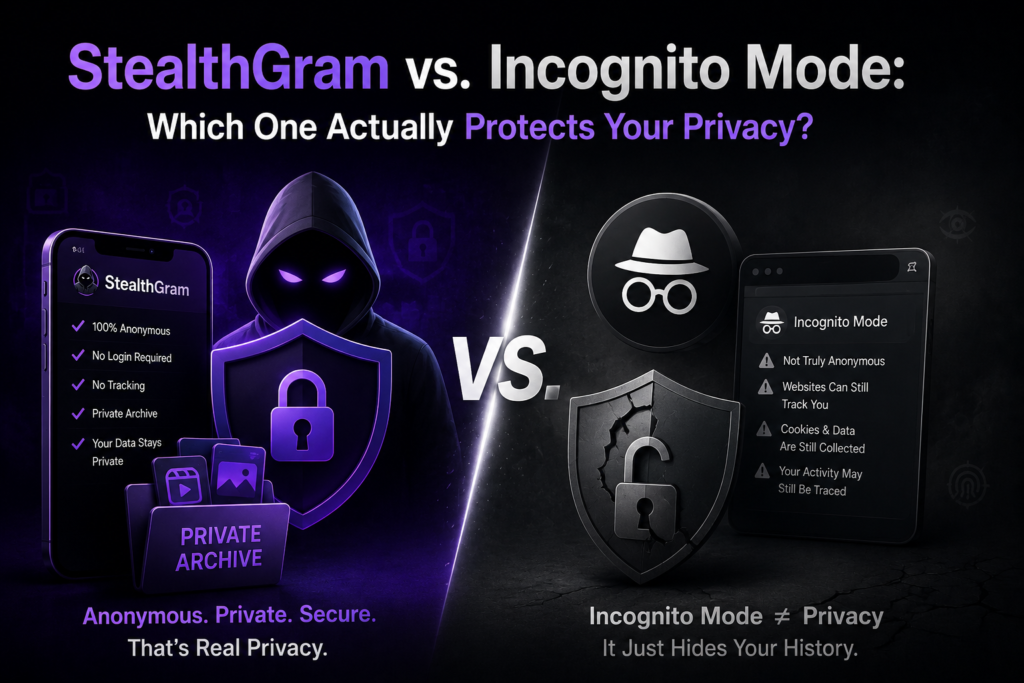

In an era where every click, view, and scroll is tracked by sophisticated algorithms, the quest for digital anonymity has never been more urgent. Users are increasingly seeking ways to navigate social media platforms without leaving a digital trail that can be used for targeted advertising, social engineering, or unwanted data harvesting. Two common solutions often discussed in this context are StealthGram and the standard “Incognito Mode” found in most web browsers. While both promise a level of privacy, they operate on entirely different levels of the digital stack. To understand which one truly protects your privacy, we must dissect their mechanics, their limitations, and their intended use cases.
Understanding Incognito Mode: The Local Shield
Most internet users are familiar with Incognito Mode (or “Private Browsing”). When you open an incognito window, your browser stops saving your browsing history, cookies, site data, and information entered in forms for that specific session. It is effectively a “local shield.”
How it works:
Incognito mode ensures that once you close the window, anyone else using the same computer or device cannot see what you were doing. It is excellent for tasks like buying a gift on a shared family computer or logging into a second email account without signing out of your primary one.
The Privacy Gap:
The biggest misconception about Incognito Mode is that it makes you invisible to the websites you visit. This is fundamentally untrue. When you use Incognito Mode to browse social media:
- The Platform Still Tracks You: If you log into your account, the platform tracks every action as usual.
- IP Address Visibility: Your IP address remains visible to the website and your Internet Service Provider (ISP).
- Fingerprinting: Websites can still use “browser fingerprinting” (analyzing your screen resolution, fonts, and hardware) to identify you even without cookies.
In short, Incognito Mode protects you from the people in your house, but it does very little to protect you from the platform giants.
Entering the Era of StealthGram: The Server-Side Ghost
StealthGram represents a different philosophy of privacy. Rather than trying to hide your history locally, StealthGram focuses on severing the connection between your identity and the platform you are viewing. It acts as a specialized intermediary designed specifically for the complexities of modern social media architectures.
How it works:
When you use StealthGram, you are not interacting with the social media platform directly. Instead, you are sending a request to the StealthGram servers. Their system fetches the public data—be it a story, a post, or a profile—and displays it to you on an independent interface. Because you never log in and never touch the platform’s servers with your own IP, you become a “ghost” in the machine.
The Deep Dive: Privacy Comparison
To determine which tool actually protects your privacy, we need to look at specific scenarios where users typically seek anonymity.
1. Viewing Stories and Profiles
If you use Incognito Mode to view an Instagram story, you still have to log in to see it (unless it’s a public profile viewed via a web link). The moment you log in, your privacy is gone; the account holder will see your name in their “viewed by” list.
In contrast, StealthGram allows you to view these stories without an account. The platform sees a request from a StealthGram server, but it has no way of knowing that you are the person behind that request. This makes StealthGram the superior choice for those who need to view content without notifying the creator.
2. Data Harvesting and Advertising
Standard browsers, even in Incognito Mode, are designed to facilitate the web’s ecosystem, which relies heavily on data. They still communicate a vast amount of metadata to the sites you visit.
StealthGram strips away this metadata. Because it serves as a “read-only” gateway, it prevents the platform from building a shadow profile of your interests based on how long you linger on a photo or which profiles you visit most often. For users concerned about the “Big Brother” aspect of social media algorithms, StealthGram provides a level of isolation that Incognito Mode simply cannot match.
Professional vs. Personal Privacy
The choice between these tools often depends on the “threat model” of the user.
- For the Personal User: If you just want to check a recipe without it cluttering your search history, Incognito Mode is sufficient. However, if you want to check up on an ex-partner or a friend without the social awkwardness of “seen” receipts, StealthGram is the necessary tool.
- For the Professional: For journalists, private investigators, or corporate researchers, Incognito Mode is dangerous. It provides a false sense of security. These professionals rely on StealthGram to conduct “Open Source Intelligence” (OSINT). In professional settings, revealing your presence to a subject can compromise an entire investigation. StealthGram ensures that the “observer effect”—where the act of observing changes the behavior of the subject—is eliminated.
Security and Ethical Considerations
While StealthGram offers superior privacy, it is important to discuss the security of the tools themselves. A common pitfall for privacy-seekers is using unverified third-party apps that claim to offer “stealth” features but actually steal login credentials.
The gold standard for a StealthGram utility is that it must not require a login. If a tool asks for your password to show you someone else’s story anonymously, it is a security risk, not a privacy tool. True StealthGram functionality relies on fetching public data via proxy, which keeps your own account entirely out of the loop.
Ethically, StealthGram is often debated. Some argue that creators have a right to know who is viewing their content. However, in the context of the “Right to be Forgotten” and the right to consume public information without being tracked, StealthGram serves as a vital counterweight to the invasive nature of modern tech.
Why StealthGram Wins the Privacy Battle
When we ask “which one actually protects your privacy,” we must define privacy as the ability to control what information you share about yourself.
Incognito Mode only controls what information is stored on your device. It gives you zero control over what the social media platform knows about you. StealthGram, on the other hand, gives you total control over your digital presence. It allows you to consume public information while sharing zero personal data in return.
The Benefits of the StealthGram Approach:
- Zero Footprint: No “seen” receipts, no “viewed” logs.
- Algorithm Avoidance: Your viewing habits don’t influence your future ad profile.
- Account Safety: Since you don’t log in, your primary account is never at risk of being flagged or banned for “automated” behavior.
- IP Masking: Your physical location and device details are never shared with the social media giant.
The Future of Anonymous Browsing
As we move deeper into 2026, the battle for privacy will only intensify. We are seeing platforms experiment with even more invasive tracking, such as eye-tracking via mobile cameras or biometric engagement metrics. In this environment, basic tools like Incognito Mode are becoming obsolete for anything other than hiding local history.
The future belongs to decentralized and proxy-based solutions like StealthGram. These tools recognize that the only way to truly be private on the modern web is to not be there at all—at least not in a way that can be tied back to your real-world identity.
Final Verdict
If you are looking for true privacy on social media, Incognito Mode is a half-measure. It is a screen door in a rainstorm—it might stop the wind, but you’re still going to get wet. StealthGram is the umbrella. It is a purpose-built shield that understands the specific ways social media platforms track users and provides a direct, technical solution to block those methods.
For anyone serious about their digital sovereignty, the choice is clear. Use Incognito Mode for your local browser housekeeping, but use StealthGram for your social media interactions. By combining these approaches, you can navigate the digital world with the confidence that your private life remains exactly that—private.
Key Summary Table: StealthGram vs. Incognito Mode
| Feature | Incognito Mode | StealthGram |
| Hides History from Housemates | Yes | Yes |
| Hides Activity from Instagram | No | Yes |
| Requires Account Login | Usually Yes | No |
| Masks IP Address | No | Yes |
| Prevents “Seen” Receipts | No | Yes |
| Protects against Fingerprinting | Limited | High |
In the end, the most powerful tool in your privacy arsenal is knowledge. Understanding that Incognito Mode has limits allows you to seek out more robust solutions like StealthGram. In the modern age, staying hidden isn’t about being a “lurker”—it’s about being a smart, protected digital citizen.