
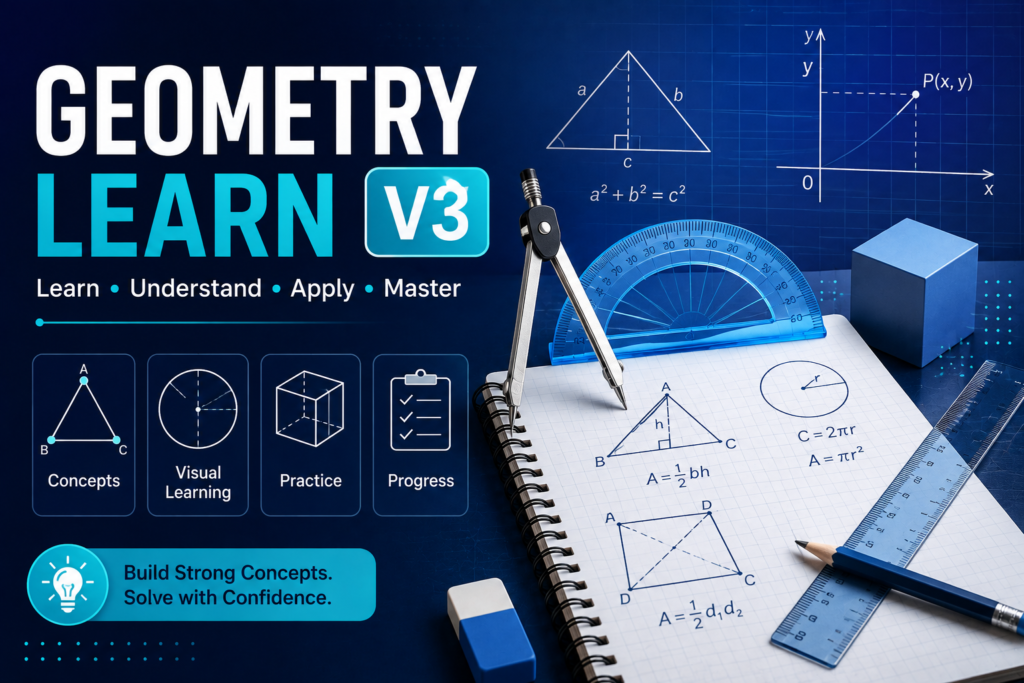

Geometry is one of those subjects that becomes much easier when you stop trying to memorize every rule and start understanding how shapes, measurements, angles, and relationships work together. If you have come across the term Geometry Learn V3, you may be looking for a structured way to improve your geometry knowledge, practice important concepts, and become more confident when solving problems.
Whether you are a student revising for an exam, a beginner learning geometry from scratch, or someone looking for a more organized approach to mathematical concepts, having a clear learning method can make a significant difference.
What Is Geometry Learn V3?
Geometry Learn V3 can be approached as a modern, structured way of learning geometry concepts through progressive practice and visual understanding. The idea behind a versioned learning approach is simple: instead of studying unrelated formulas one after another, learners build their knowledge from basic shapes and definitions toward more challenging geometric relationships.
Geometry is highly visual. A diagram can often explain something that would take several paragraphs to describe. For this reason, an effective geometry learning experience should combine explanations, examples, diagrams, formulas, and problem-solving exercises.
The “V3” part of the keyword may refer to a particular version, resource, or learning project. Since the term can be used in different contexts, it is useful to focus on the core educational value associated with learning geometry systematically.
Why Learning Geometry Step by Step Matters
Many learners struggle with geometry because they begin with formulas without understanding what those formulas represent. For example, memorizing the area formula for a triangle is less useful than understanding why the area depends on its base and height.
A progressive approach helps connect individual concepts.
You might begin with:
- Points, lines, and line segments
- Angles and their measurements
- Basic two-dimensional shapes
- Perimeter and area
- Triangles and their properties
- Quadrilaterals and polygons
- Circles
- Coordinate geometry
- Transformations
- Three-dimensional geometry
Each topic provides knowledge that can support the next one. Once these relationships become familiar, complicated problems become less intimidating.
Core Geometry Concepts to Understand
Points, Lines, and Angles
The foundation of geometry begins with simple objects such as points, lines, rays, and line segments. From there, learners encounter different types of angles, including acute, right, obtuse, straight, and reflex angles.
Understanding angles is especially important because they appear throughout geometry. Angle relationships can help you determine missing measurements, identify shapes, and solve problems involving parallel or intersecting lines.
Shapes and Their Properties
Geometry becomes more practical when you learn how to identify shapes based on their properties.
A square, for example, has four equal sides and four right angles. A rectangle also has four right angles, but only opposite sides need to be equal. A triangle has three sides, but triangles can be classified in different ways depending on their side lengths and angles.
Instead of simply remembering names, focus on what makes each shape different.
Perimeter and Area
Perimeter describes the distance around a two-dimensional shape, while area measures the amount of space inside it.
For a rectangle:
Perimeter = 2 × (length + width)
Area = length × width
These concepts are among the most practical parts of geometry because they connect mathematics with real-world situations such as measuring rooms, designing spaces, estimating materials, and planning layouts.
Triangles
Triangles deserve special attention because they appear in many areas of mathematics.
Important triangle classifications include equilateral, isosceles, and scalene triangles. Triangles can also be classified according to their angles, such as acute, right, and obtuse triangles.
One of the most important facts to remember is that the interior angles of a triangle always add up to 180 degrees.
Right triangles introduce another major concept: the Pythagorean theorem.
a² + b² = c²
Here, c represents the hypotenuse of a right triangle. Understanding this relationship can help solve problems involving unknown side lengths.
Geometry Learn V3 and Visual Learning
One of the strongest ways to improve at geometry is to make the subject visual.
When working through a problem, draw the shape whenever possible. Label the known measurements and mark the information that the question asks you to find.
For example, if a problem describes two intersecting lines and gives you one angle, creating a quick diagram can make the relevant angle relationships immediately easier to recognize.
Digital geometry tools can make this process even more interactive. Learners can experiment with shapes, move points, change measurements, and observe how geometric relationships respond.
This type of exploration can turn geometry from a collection of static formulas into something that feels more intuitive.
How to Study Geometry More Effectively
A good geometry routine does not require hours of memorization. Consistent practice is usually more useful.
Start by learning the definition of a concept. Then look at a simple example. After that, attempt a problem without immediately checking the answer.
When you make a mistake, do not simply erase it and move on. Ask why the mistake happened.
Was the wrong formula used?
Was a measurement misunderstood?
Was the diagram interpreted incorrectly?
Was a calculation skipped?
Identifying the reason behind an error helps prevent the same problem from appearing again.
Another useful strategy is to mix different types of questions. Solving ten identical problems may make you comfortable with one formula, but mixed practice forces you to decide which concept is actually relevant.
Common Mistakes Beginners Make
Geometry problems can look complicated even when the underlying mathematics is simple. A few common mistakes can make them harder than necessary.
One mistake is confusing area with perimeter. Another is using the wrong measurement in a formula. Learners also sometimes assume that a diagram is drawn to scale when the problem does not say so.
Another common issue is skipping units. If a question asks for an area, the answer should normally use square units. A length uses ordinary units, while volume uses cubic units.
Careful reading is therefore just as important as calculation.
Building Confidence Through Practice
The biggest advantage of a structured resource such as Geometry Learn V3 is the opportunity to approach geometry as a progression rather than a single difficult subject.
Start with concepts you understand. Strengthen them through practice, then gradually introduce more advanced topics.
You do not need to master every geometric theorem immediately. First build a reliable foundation. Once basic relationships become familiar, more advanced problems become easier to break down.
A useful mindset is to treat every geometry question as a puzzle. Identify what you know, determine what you need to find, choose the geometric relationship that connects the two, and then work through the calculation carefully.
Final Thoughts
Geometry Learn V3 can be viewed as a useful keyword for a structured approach to understanding geometry through concepts, visualization, examples, and practice. The most effective way to learn geometry is not simply to memorize formulas but to understand when and why those formulas work.
From basic points and angles to triangles, circles, coordinate geometry, and three-dimensional shapes, each concept adds another piece to the bigger mathematical picture.
With regular practice and a focus on understanding rather than memorization, geometry can become much more manageable. Start with the fundamentals, use diagrams whenever possible, review your mistakes, and gradually challenge yourself with more complex problems. That approach can turn geometry from a confusing collection of rules into a subject you can confidently work through.