
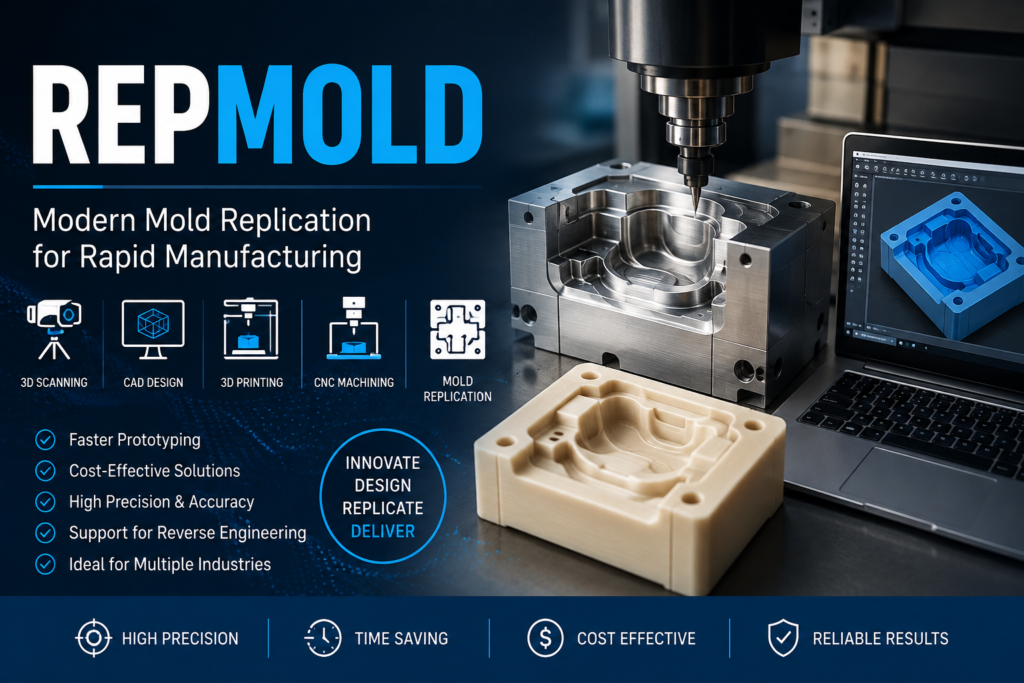

Manufacturing is evolving rapidly, and businesses are constantly searching for smarter ways to design, test, and produce products. One term that has recently gained attention in discussions around digital manufacturing and mold development is Repmold. Although Repmold does not have a universally standardized technical definition, it is commonly associated with modern approaches to mold replication, rapid tooling, reverse engineering, and digitally assisted manufacturing.
The concept behind Repmold is closely connected to technologies such as 3D scanning, CAD design, CNC machining, 3D printing, prototyping, and mold replication. These technologies allow manufacturers to recreate or improve molds more efficiently than relying exclusively on traditional production methods.
In this article, we will explore what Repmold means, how a Repmold-style workflow works, its benefits, applications, challenges, and its potential role in the future of manufacturing.
What Is Repmold?
Repmold is generally used as a broad term associated with the process of replicating, repairing, recreating, or rapidly developing molds using modern manufacturing technologies.
Traditional mold production can require extensive machining, specialized tooling, and significant development time. Modern digital manufacturing methods offer alternative workflows that can speed up certain stages of mold development.
A typical Repmold-style process may combine several technologies, including:
- 3D scanning
- Computer-Aided Design (CAD)
- Reverse engineering
- 3D printing
- CNC machining
- Rapid prototyping
- Silicone molding
- Casting
- Digital inspection
Instead of treating Repmold as one specific machine or standardized technology, it is more useful to understand it as a modern approach that combines different manufacturing tools to make mold development faster and more flexible.
How Does Repmold Work?
The exact process can vary depending on the product, material, required accuracy, production volume, and available equipment. However, a typical workflow may follow several important stages.
1. Capturing the Original Design
The process often begins with an existing physical object, component, or mold. If a digital design is unavailable, manufacturers may use 3D scanning technology to capture the dimensions and surface details of the original item.
The collected information can then be converted into a digital model.
2. Creating a CAD Model
Once the design data is available, engineers can use CAD software to refine the model.
This stage may involve:
- Correcting damaged areas
- Adjusting dimensions
- Improving surface details
- Adding design features
- Preparing the object for manufacturing
Digital modeling makes it easier to experiment with design changes before physical production begins.
3. Producing a Master Pattern
After completing the digital design, a master pattern may be created using technologies such as 3D printing or CNC machining.
The master pattern acts as a reference for producing the final mold.
Depending on the application, the pattern may require finishing processes such as sanding, polishing, sealing, or surface treatment.
4. Creating the Mold
The next step is producing the mold itself.
Different materials can be used depending on the production requirements. For example, flexible materials may be suitable for short production runs and casting applications, while metal tooling may be preferred for high-volume industrial manufacturing.
The selection of mold material depends on several factors, including:
- Required durability
- Production quantity
- Material being molded
- Temperature requirements
- Pressure requirements
- Surface finish expectations
5. Testing and Quality Inspection
Before large-scale production begins, manufacturers typically test the mold and inspect the produced components.
This stage helps identify issues related to:
- Dimensional accuracy
- Surface quality
- Material flow
- Shrinkage
- Tolerances
- Structural strength
Digital inspection tools can help manufacturers compare the finished component with the original design.
Key Benefits of Repmold
One of the main reasons modern mold replication and rapid tooling methods are becoming increasingly important is flexibility.
Faster Product Development
Traditional manufacturing processes can require significant time to develop tooling. Digital design and rapid prototyping technologies can help shorten development cycles, especially during the testing and prototype stages.
Companies can evaluate multiple design concepts without waiting for conventional production tooling to be completed.
Improved Design Flexibility
Digital models are easier to modify than physical tooling.
If engineers discover a problem during testing, they can update the CAD model and create a revised prototype. This flexibility can make product development more efficient.
Support for Reverse Engineering
Repmold-style workflows can also be useful when original design files are missing.
For example, an old component may no longer have accessible CAD files. A manufacturer can potentially scan the physical object, rebuild the geometry digitally, and create a new production solution.
This makes digital replication valuable for replacement parts and legacy manufacturing equipment.
Lower Prototype Costs
Developing permanent industrial tooling can be expensive.
For prototypes and small production runs, alternative tooling methods may provide a more cost-effective solution. Companies can test market demand before investing heavily in long-term manufacturing equipment.
Reduced Material Waste
Digital manufacturing technologies can also support more efficient production planning.
By testing designs digitally and producing prototypes before committing to large-scale manufacturing, businesses may reduce unnecessary material use and avoid costly production mistakes.
Industries That Can Benefit from Repmold
The technologies associated with Repmold can be useful across many industries.
Automotive Industry
Automotive manufacturers frequently develop prototypes and replacement components. Digital scanning and mold replication can help engineers reproduce existing parts or test new designs.
Consumer Products
Companies producing consumer goods often need to test multiple product versions. Rapid tooling and prototype molds can make it easier to evaluate designs before mass production.
Medical Manufacturing
Precision is extremely important in medical manufacturing. Digital design and inspection technologies can support the development of customized components and specialized production tools.
Aerospace
Aerospace companies require highly accurate components and strict quality control. Advanced digital manufacturing technologies can support design validation and prototype development.
Electronics
Electronic products often contain small and complex components. Rapid prototyping and precise mold development can help manufacturers test product designs more efficiently.
Repmold and 3D Printing
It is important to understand that Repmold and 3D printing are not necessarily the same thing.
3D printing is an additive manufacturing process that creates objects layer by layer from a digital model.
Molding, on the other hand, involves using a mold or tool to shape a material into a specific form.
However, both technologies can work together.
For example, a manufacturer may use a 3D printer to create a master pattern. That master can then be used to create a mold for producing multiple copies.
This combination provides flexibility during product development and small-batch manufacturing.
Challenges and Limitations
Despite its potential benefits, modern mold replication also has limitations.
Rapid tooling may not always be suitable for high-volume production. Large-scale manufacturing often requires highly durable tooling capable of handling repeated production cycles.
Other challenges can include:
- Accuracy limitations
- Material shrinkage
- Surface finishing requirements
- Tool durability
- Temperature resistance
- Production tolerances
For this reason, manufacturers must select the right process based on the specific requirements of each project.
A prototype mold that performs well during testing may not necessarily be suitable for long-term industrial production.
The Future of Repmold and Digital Manufacturing
The future of manufacturing will likely involve greater integration between digital design and physical production.
Technologies such as artificial intelligence, automation, advanced CAD software, 3D scanning, additive manufacturing, and digital inspection are changing how companies develop products.
While Repmold itself is not a universally standardized manufacturing term, the broader concepts associated with it represent an important direction for modern production.
Manufacturers increasingly need faster development cycles, greater customization, and more efficient workflows. Digital mold development and replication techniques can help businesses respond to these demands.
Final Thoughts
Repmold can be understood as a modern concept connected with mold replication, rapid tooling, reverse engineering, and digitally assisted manufacturing.
Rather than representing one specific machine or universally defined technology, it describes a broader approach that can combine CAD design, 3D scanning, 3D printing, machining, prototyping, and mold development.
The biggest advantage of these technologies is flexibility. Businesses can recreate existing components, test new ideas, develop prototypes, and improve production workflows without relying entirely on traditional tooling methods.
As digital manufacturing continues to evolve, approaches related to rapid mold development and replication are likely to become increasingly valuable. For companies focused on innovation, customization, and faster product development, understanding the principles behind Repmold can provide useful insight into the future of modern manufacturing.