
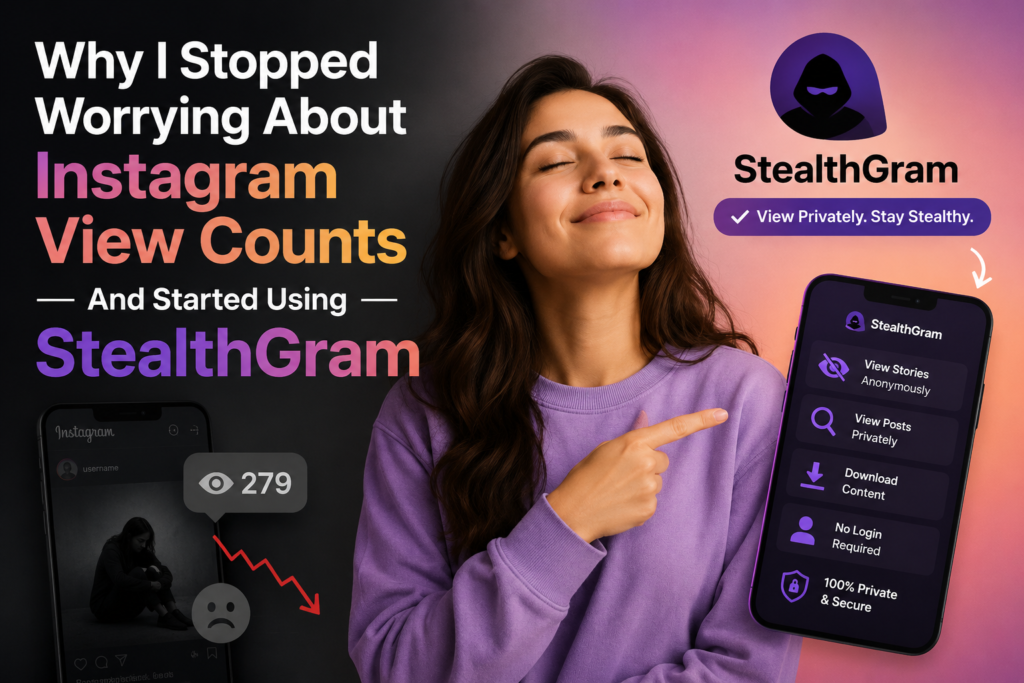

There’s a specific kind of anxiety that comes with Instagram. Not the performative kind — the one where you’re worried about how many likes your post got. I’m talking about the other side of it. The viewer’s anxiety. That little moment of hesitation before you tap on someone’s story, knowing full well that the second you do, your name shows up on their list.
I used to overthink it constantly. Should I watch this? Will it be weird if they see me? What if they screenshot the viewer list? It sounds dramatic, but if you’ve ever been in a situation where you needed to keep tabs on something — a competitor’s brand, an ex’s updates, a family situation you’re not directly involved in — you know exactly what I mean. Instagram’s default setup makes quiet observation basically impossible.
That’s what eventually led me to StealthGram, and honestly, it changed how I use Instagram entirely.
The Problem Nobody Talks About Openly
Most people don’t admit they want to browse Instagram anonymously because it sounds creepy when you say it out loud. But the reality is far more mundane. Marketers monitor competitor accounts. Journalists follow public figures without wanting to signal their interest. Parents keep an eye on public profiles their kids interact with. People going through personal situations — breakups, family drama, workplace conflict — want to understand what’s happening without inserting themselves into it.
None of this is sinister. It’s just human. And yet Instagram treats every view like a social event that needs to be announced.
StealthGram exists precisely because this need is real and widespread. It’s a tool that lets you view public Instagram content — stories, posts, highlights, reels — without your identity being logged anywhere. Instagram never knows you looked. The person whose profile you visited never sees your name.
What StealthGram Actually Does (Without the Technical Jargon)
I’ll keep this simple because honestly, the tool itself is simple. You go to StealthGram, you type in a public Instagram username, and you see their content. No login required on your end. No Instagram account needed. You’re not signing in through a third party or giving anyone your credentials. You’re just viewing public content through a neutral layer that doesn’t report back to Instagram.
The key word there is “public.” StealthGram works with publicly accessible profiles — accounts that anyone on the internet could technically view. What it does differently is remove the identifying fingerprint that Instagram would normally attach to your viewing session. Where Instagram would log “this user viewed this story at this time,” StealthGram essentially removes you from that equation entirely.
It’s cleaner than you’d expect. No cluttered interface, no aggressive ads asking you to sign up for something, no shady permission requests. You search a username, you get results, you browse. That’s it.
The Fake Account Alternative (And Why It’s More Trouble Than It’s Worth)
Before I found StealthGram, I did what a lot of people do — I considered making a secondary Instagram account. A finsta, basically. A throwaway profile with a vague name and no profile picture that I could use to quietly browse without my real identity attached.
Here’s why that’s a bad idea in 2026.
Instagram is genuinely sophisticated at this point. Their systems flag new accounts for suspicious behavior, especially when those accounts are created with the express purpose of lurking. If you use the same Wi-Fi, the same device, or log in from the same IP address as your main account, Instagram can and will connect the dots. There are documented cases of people getting their real accounts restricted or flagged because of activity on linked fake accounts.
Beyond the technical risk, it’s just exhausting. You’re maintaining a whole fake digital identity just to browse quietly. StealthGram solves the same problem in about thirty seconds with zero ongoing effort.
Real Use Cases Where StealthGram Makes a Genuine Difference
Competitor research: If you run any kind of business with an Instagram presence, you’re already watching what competitors post. With StealthGram, you can do that research without tipping them off. They won’t see your brand name in their story viewers. Your interest stays private.
Reconnecting with old contacts: Sometimes you want to see how someone’s doing without the social weight of following them or reaching out. Maybe it’s an old friend from a complicated chapter of your life. StealthGram lets you satisfy that curiosity without creating an interaction you’re not ready for.
Journalism and research: Public figures post publicly precisely because they want their content seen — but journalists and researchers often prefer not to signal which stories or accounts they’re investigating. StealthGram supports that kind of low-profile information gathering on public content.
Personal situations: Breakups, family estrangements, workplace situations — sometimes you need information without the visibility. StealthGram handles this without judgment and without a paper trail.
What About Privacy and Safety? Is StealthGram Itself Trustworthy?
This is the right question to ask about any tool in this category. The anonymous Instagram viewer space has some bad actors — tools that ask for your login details, plant trackers, or collect browsing data and sell it. Those tools are giving the whole category a bad name.
StealthGram operates differently. There’s no login prompt, no account creation, no cookie wall demanding you hand over personal information to proceed. You’re not the product. The service doesn’t need your data to function because it’s designed around accessing public content, not your private account.
I’d still recommend basic digital hygiene regardless — use a browser you trust, don’t hand over personal information unnecessarily, and if anything ever feels off about a tool you’re using, stop. But in my experience, StealthGram passes the basic smell test that many tools in this space don’t.
The Bigger Picture: Privacy as a Default, Not a Premium
There’s something philosophically off about the current state of social media. Platforms have been designed to maximize engagement and data collection, which means every action you take — every view, every tap, every second of watch time — gets logged and analyzed. The idea that browsing should be inherently invisible, like walking through a bookshop without being tracked, has been quietly abandoned.
StealthGram is a small pushback against that. It doesn’t claim to fix the internet. It just carves out a space where you can browse public Instagram content on your own terms, without your curiosity being announced to the person you’re curious about.
That matters more than it sounds. The ability to observe without being observed — to gather information quietly, to check in on something without creating a social obligation — is a basic human behavior that digital platforms have been slowly eroding. Tools like StealthGram restore a little bit of that balance.
Final Thoughts
I’m not someone who thinks about online privacy in abstract, theoretical terms. I got interested in StealthGram for a boring, practical reason: I wanted to check something on Instagram without the other person knowing. What I found was a tool that’s genuinely well-built, genuinely private, and genuinely useful for situations that come up more often than people admit.
If you’ve ever hesitated before tapping a story because you didn’t want your name on that list, StealthGram is worth knowing about. It solves a real problem cleanly, without the baggage of fake accounts or the false promise of browser tricks that stopped working years ago.